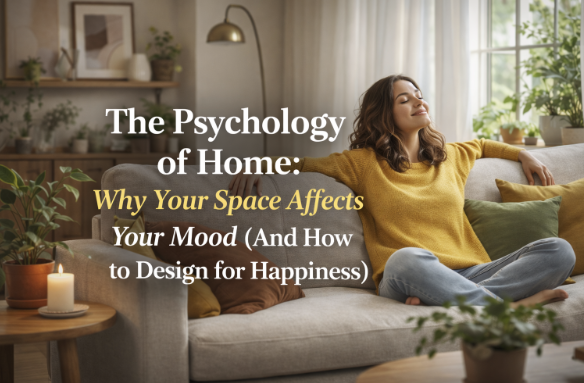
The Psychology of Home: Why Your Space Affects Your Mood (And How to Design for Happiness)

Have you ever noticed how you feel instantly calmer in certain spaces? How some rooms energize you while others drain your motivation? Or why you can't seem to focus in one area of your home but feel creative and inspired in another? These aren't random occurrences or simple preferences. There's actual science behind why your physical environment profoundly impacts your mental state, productivity, relationships, and overall well-being.
Environmental psychology—the study of how our surroundings influence our behavior and emotions—reveals something fascinating: our homes are constantly communicating with our brains, triggering responses we're often not consciously aware of. Every color, texture, light source, and spatial arrangement sends signals that either support or undermine our mental health. The exciting part? Once you understand these principles, you can intentionally design your space to enhance specific moods, behaviors, and outcomes in your life.
This isn't about following arbitrary design trends or creating Instagram-worthy rooms. This is about understanding the invisible forces at play in your environment and using them strategically to create a home that actually makes you happier, healthier, and more productive. Let's explore the science and apply it to your real life.
Color Psychology: More Than Just Pretty Walls
We've all heard basic color advice—blue is calming, red is energizing, yellow is cheerful. But the reality of color psychology is far more nuanced and powerful than these simplified rules suggest. Colors don't just affect your mood; they influence your heart rate, appetite, perception of temperature, and even your ability to make decisions.
Research in neuroscience shows that color is processed by the same part of the brain that handles emotions and memory. This means colors trigger emotional responses before your rational brain even gets involved. Blue genuinely does lower blood pressure and heart rate, which is why it's so effective in bedrooms and bathrooms where relaxation is the goal. But here's what most people don't know: the shade, saturation, and amount of blue matter enormously. A pale, dusty blue creates tranquility, while a bright, saturated blue can actually feel stimulating rather than calming.
Red increases energy and appetite, which makes it problematic in bedrooms if you struggle with sleep but potentially useful in dining areas where you want to encourage conversation and appetite. However, you don't need red walls to harness this effect. Strategic pops of red in artwork, throw pillows, or decorative objects can provide the energizing benefit without overwhelming the space.
Yellow deserves special attention because it's perhaps the most psychologically complex color. In the right shade and amount, yellow promotes optimism, creativity, and mental clarity—perfect for home offices or creative spaces. But too much yellow or overly bright shades can actually increase anxiety and agitation. Babies reportedly cry more in yellow rooms, and adults feel more irritable. The sweet spot is soft, warm yellows used as accents rather than dominant colors.
Green is having a moment in design circles, and psychologically, this makes perfect sense. Our brains are hardwired to respond positively to green because it signals nature, growth, and safety. Green reduces stress, aids concentration, and creates feelings of balance. It's one of the most versatile colors psychologically, working beautifully in nearly any room. The key is choosing the right shade—sage and olive feel sophisticated and grounding, while brighter greens energize without the intensity of red or orange.
The practical application? Choose colors based on what you want to feel and do in each space, not just what looks pretty. Your bedroom's primary function is rest, so lean toward blues, soft greens, or muted earth tones. Your home office needs to support focus and creativity, making green an excellent choice. Your kitchen and dining areas benefit from warmer tones that stimulate appetite and conversation—think warm whites, soft yellows, or terracotta.
Lighting: The Mood Manipulator You're Probably Ignoring
If color is powerful, lighting is absolutely transformative. Yet it's the element most people get wrong in their homes. Harsh overhead lighting, mismatched bulb temperatures, and insufficient task lighting don't just look bad—they actively harm your mood, energy levels, and even your health.
Your body's circadian rhythm—the internal clock that regulates sleep, hormone production, and countless other functions—is primarily controlled by light exposure. When you get lighting wrong in your home, you're essentially confusing your body about what time it is and what it should be doing. This manifests as difficulty sleeping, low energy, mood swings, and that general sense of malaise you can't quite explain.
Here's the science: cooler, brighter light (5000K-6500K on the Kelvin scale) mimics daylight and signals to your brain that it's time to be alert and productive. This is perfect for morning routines and work spaces. Warmer, dimmer light (2700K-3000K) mimics sunset and firelight, triggering melatonin production and preparing your body for rest. This should dominate your evening spaces.
The problem is that most people use the same lighting temperature throughout their homes and throughout the day. Your bedroom has the same harsh, cool bulbs as your bathroom. Your living room lighting doesn't change from morning to evening. You're essentially creating perpetual noon or perpetual midnight in your home, and your body doesn't know how to respond.
Layered lighting solves this beautifully while also creating visual interest and flexibility. Ambient lighting (overhead fixtures) provides general illumination. Task lighting (desk lamps, reading lights, under-cabinet fixtures) supports specific activities. Accent lighting (picture lights, decorative lamps, candles) creates atmosphere and highlights features. When you combine these three types with appropriate color temperatures, you can actually guide your energy levels and mood throughout the day.
Consider your morning bathroom routine. Cool, bright lighting helps you wake up and see clearly for grooming tasks. But that same bathroom in the evening should have the option for warmer, dimmer light that doesn't disrupt your wind-down process. Dimmer switches and lamps with adjustable color temperatures give you this control without requiring multiple fixtures.
Natural light deserves its own discussion because it's the most psychologically beneficial light source available. Exposure to natural light improves mood, increases vitamin D production, regulates circadian rhythms, and even boosts productivity. Position your most-used spaces to maximize natural light. Use sheer curtains that filter without blocking light during the day. Add mirrors across from windows to amplify natural light throughout rooms. If you have spaces with limited natural light, consider daylight-spectrum bulbs that mimic the sun's qualities.
Clutter and Chaos: The Hidden Mental Load
Here's an uncomfortable truth: clutter isn't just unsightly; it's cognitively and emotionally exhausting. Neuroscience research using fMRI scans shows that cluttered environments literally compete for your attention, making it harder to process information and regulate emotions. When you're in a cluttered space, your brain is constantly processing visual stimuli, leaving less mental bandwidth for everything else.
A Princeton University study found that physical clutter negatively affects your ability to focus and process information. UCLA researchers discovered that women who described their homes as cluttered had higher levels of cortisol (the stress hormone) throughout the day. The implications are significant: your cluttered countertops and overstuffed closets aren't just annoying; they're actively stressing you out and impairing your cognitive function.
But here's where it gets interesting for home design: the solution isn't minimalism or getting rid of everything you own. The solution is strategic storage and intentional display. Your brain responds negatively to visual chaos, not to objects themselves. When items have designated homes and surfaces are clear, your stress levels drop even if you own the same amount of stuff.
This is where thoughtful furniture and storage solutions become mental health tools rather than just organizational aids. Closed storage options—cabinets, storage benches, decorative boxes—hide visual clutter while keeping items accessible. Open shelving can work beautifully, but only when styled intentionally with breathing room between objects. The rule of thirds applies: roughly one-third of shelf space should remain empty to create visual calm.
Your bedroom deserves special attention because environmental chaos directly impacts sleep quality. Research shows that people with cluttered bedrooms take longer to fall asleep and report lower sleep quality than those with clear, organized spaces. If your bedroom contains piles of laundry, work materials, exercise equipment, and random items without homes, your brain sees it as a space with unfinished business rather than a sanctuary for rest.
The practical step? Start with surfaces. Clear kitchen counters except for your most-used items and perhaps one decorative element. Clear your nightstands except for a lamp and perhaps one book. Clear your coffee table. You'll feel the mental shift almost immediately. Then tackle storage systematically, one area at a time, ensuring everything has a designated home.
Biophilic Design: Bringing Nature Indoors for Mental Health
Humans spent roughly 99.9% of our evolutionary history outdoors, surrounded by nature. Our brains and bodies evolved in natural environments, yet modern life keeps us inside approximately 90% of the time. This disconnect has consequences: increased stress, anxiety, depression, and physical health problems. Biophilic design—the practice of incorporating nature into built environments—bridges this gap and provides measurable mental health benefits.
The research is compelling. Hospital patients with window views of nature recover faster and require less pain medication than those facing brick walls. Office workers with views of nature report higher job satisfaction and lower stress. Students in classrooms with natural elements show improved attention and academic performance. Simply looking at nature—even images of nature—reduces stress markers in the body.
You don't need a wall of windows overlooking a forest to harness these benefits. Strategic incorporation of plants, natural materials, natural light, and nature-inspired elements creates the effect. Live plants provide multiple benefits: they improve air quality, reduce stress, increase humidity in dry environments, and give you something living to care for, which itself provides psychological benefits.
The type of plants matters less than you might think—even low-maintenance options like pothos, snake plants, and succulents provide psychological benefits. The key is choosing plants that will thrive in your specific light conditions so they remain healthy and vibrant rather than becoming another source of stress. Place plants at eye level where you'll see them regularly rather than tucked in corners where they're forgotten.
Natural materials—wood, stone, bamboo, cotton, linen—create textural interest while connecting spaces to the natural world. A wooden coffee table, stone countertops, bamboo cutting boards, linen curtains—these aren't just design choices; they're biophilic elements that make spaces feel more grounding and less sterile. The variation and imperfection in natural materials also appeals to our brains more than perfectly uniform synthetic materials.
Water features provide both visual and auditory nature connections. A small tabletop fountain in your office or living room creates the soothing sound of running water, which measurably reduces stress and can even mask distracting noises in busy households. Natural light, which we discussed earlier, is perhaps the most crucial biophilic element, connecting you to the daily and seasonal rhythms of the outside world.
Views matter too. If you're fortunate enough to have nature views from your windows, orient your furniture to take advantage of them. Position your desk, favorite reading chair, or dining table where you can see trees, sky, or garden. If your views are less inspiring, create nature views indoors through strategically placed plants, nature photography, or even well-designed aquariums.
Spatial Arrangement: How Layout Affects Behavior and Relationships
The way furniture is arranged in a room doesn't just affect traffic flow and aesthetics; it fundamentally influences how people behave and interact in that space. Environmental psychologists have studied this extensively, revealing that spatial arrangement can encourage or discourage conversation, create feelings of safety or exposure, and even influence how long people stay in a space.
Consider your living room. If all seating faces a television, you've created a space optimized for media consumption but terrible for conversation. People naturally orient their bodies toward what's most important in a space, and furniture arrangement communicates what that is. If family connection is important to you but your furniture arrangement suggests TV watching is the priority, there's a disconnect between your values and your environment.
Conversation areas should position seating pieces at roughly 90-degree angles to each other rather than directly across or side-by-side. This allows for comfortable eye contact without the intensity of directly facing someone and without the awkwardness of constantly turning to see the person beside you. The optimal distance between primary seating pieces is eight to ten feet—close enough for comfortable conversation but far enough to avoid feeling cramped.
The concept of "prospect and refuge" from evolutionary psychology explains why certain furniture placements feel inherently comfortable while others create low-level anxiety. Our ancestors survived by being able to see threats coming (prospect) while having safe places to retreat (refuge). In modern homes, this translates to preferring seats with a view of the room and entry points, ideally with some support behind us. This is why corner seats are so desirable and why chairs floating in the middle of rooms with their backs to entrances feel uncomfortable even if we can't articulate why.
Dining spaces benefit from understanding these principles too. Circular or oval tables encourage more egalitarian conversation than rectangular tables, where the ends become power positions. The distance from kitchen to dining area affects how often you'll actually eat meals together versus grabbing food and wandering off—if it's too far or requires navigating obstacles, convenience trumps intention every time.
Home offices present unique spatial challenges because they require supporting focus while often being squeezed into multipurpose spaces. Ideally, position your desk so you face into the room with a wall behind you (refuge) and can see the door (prospect). If you must face a wall, place a mirror or reflective surface that lets you see the room behind you. Separate work spaces from relaxation spaces as much as possible—even in small homes, a folding screen or bookshelf can create psychological separation between work and rest zones.
Scent and Sound: The Invisible Mood Designers
We focus so much on visual elements that we often neglect the powerful impact of scent and sound on our psychological state. Yet smell is directly linked to the limbic system—the brain's emotional center—making it uniquely powerful for triggering memories and emotions. Sound affects everything from stress levels to concentration to how spacious a room feels.
Scent marketing is an entire industry because companies know that specific scents influence behavior. Citrus scents increase alertness and energy, making them perfect for morning kitchens and home offices. Lavender genuinely reduces anxiety and promotes sleep—not just folklore but demonstrated in clinical studies. Vanilla creates feelings of comfort and warmth. Peppermint enhances concentration and mental clarity. Pine and cedar evoke nature and create grounding, calming effects.
The key is using scent intentionally and subtly. Overwhelming artificial fragrances can trigger headaches and allergies. Natural options—essential oil diffusers, beeswax candles with essential oils, fresh flowers, herbs, citrus peels—provide benefits without the chemical overload. Match scents to room function: energizing scents in bathrooms and kitchens, calming scents in bedrooms, focusing scents in work areas.
Sound deserves more consideration in home design than it typically receives. Ambient noise affects stress levels, sleep quality, and cognitive function. Harsh sounds—traffic, loud appliances, echoing spaces—increase cortisol and make spaces feel less comfortable. Soft, natural sounds—gentle music, white noise, water features—can mask disruptive sounds while creating ambiance.
Acoustics matter too. Hard surfaces—tile, hardwood, glass—create echoes that make spaces feel less intimate and more chaotic. Soft furnishings—rugs, curtains, upholstered furniture—absorb sound and create cozier, quieter spaces. This is partly why minimalist spaces with hard surfaces everywhere often feel cold despite being aesthetically beautiful. Adding acoustic comfort through textiles improves both sound quality and perceived warmth.
Designing Your Happiness Blueprint
Understanding the psychology behind your space empowers you to make intentional choices that support your mental health and life goals. This isn't about following design rules because they're trendy; it's about recognizing that your environment is constantly shaping your emotions, behaviors, and wellbeing, and taking control of that influence.
Start by auditing your current space through a psychological lens. Which rooms make you feel energized, calm, creative, or stressed? What might be contributing to those feelings—colors, lighting, clutter, layout? You don't need to change everything at once. Small, strategic shifts based on these principles create measurable improvements in how you feel at home.
Consider your life circumstances and needs right now. Working from home and struggling with focus? Address your office lighting and spatial arrangement. Feeling anxious or stressed? Tackle clutter and introduce calming colors and biophilic elements. Having trouble sleeping? Transform your bedroom into a true sanctuary with appropriate lighting, minimal visual chaos, and calming colors.
The most beautiful part of designing with psychology in mind is that the changes support both form and function. A thoughtfully lit room with plants, clear surfaces, and appropriate colors isn't just psychologically beneficial—it's also objectively beautiful. You're not sacrificing aesthetics for wellbeing; you're creating spaces that look great and make you feel great, which is the real definition of good design.
Your home should be your greatest tool for mental health and wellbeing, not a source of stress or a neutral backdrop you tolerate. By understanding and applying these psychological principles, you transform your space from simply where you live into an active partner in your happiness and success. That's worth far more than following any design trend.
About the Author