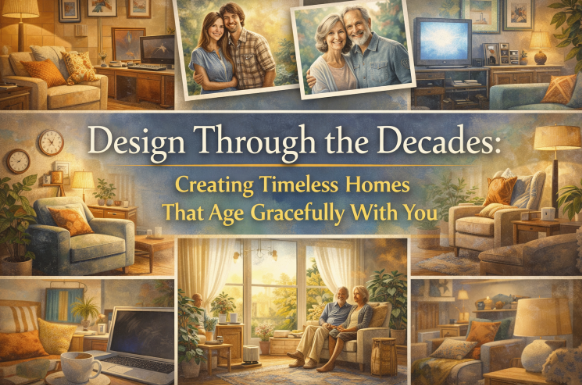
Design Through the Decades: Creating Timeless Homes That Age Gracefully With You

Walk through any neighborhood with older homes and you can instantly date their last major update. The brass fixtures and hunter green accents scream late 90s. The gray-on-gray everything announces 2015. The shiplap and farmhouse sink place you squarely in the 2018 HGTV era. These homes weren't designed poorly—they were actually quite trendy when updated. But trends, by definition, don't last. What felt fresh and current becomes dated and tired, usually faster than you'd expect.
Meanwhile, some homes possess a quality that transcends trends entirely. They feel classic rather than dated, current rather than trying too hard, comfortable rather than overly styled. These homes aren't stuck in any particular era because they were never slaves to trends in the first place. They age gracefully, adapting to their owners' changing lives without requiring complete overhauls every decade. The secret isn't avoiding style—it's understanding the difference between timeless design and trendy decoration.
The question isn't whether your taste will change as you age—it will. The question is whether your home can evolve with you or whether you'll be stuck with yesterday's trends tomorrow. Whether you're in your twenties decorating your first real place or in your sixties creating your dream retirement home, understanding how to create spaces that age gracefully with you changes everything about how you design. Let's explore how to build homes that grow alongside you through every life stage.
The Foundation: What Makes Design Timeless
Timeless design isn't about playing it safe or choosing boring options. It's about understanding which elements provide lasting satisfaction and which ones you'll regret in five years. The distinction isn't always obvious, but certain principles consistently create spaces with staying power.
Quality over quantity forms the bedrock of timeless design. One substantial, well-made sofa you genuinely love will serve you for decades. Three trendy but cheaply made pieces from fast-furniture retailers will need replacing long before your taste changes. This principle extends beyond furniture to everything in your home. Solid wood instead of particle board. Metal instead of plastic. Natural fibers instead of synthetic. These aren't just aesthetic choices—they're investments in longevity that become more cost-effective over time.
Classic proportions and lines outlast trendy silhouettes. A sofa with clean lines and classic proportions works in traditional, transitional, and even modern spaces. An overstuffed, oversized sectional with very specific styling screams a particular era and limits your future flexibility. Dining tables with simple, elegant legs adapt to changing styles around them. Tables with very trendy bases become dated anchors. This doesn't mean everything must be plain—it means choosing pieces where the basic form is classic even if details add personality.
Neutral foundations with personality in layers creates flexibility that all-trend or all-neutral spaces can't match. When your walls, floors, and major furniture pieces are relatively neutral, you can shift accent colors, patterns, and accessories as your taste evolves without replacing everything. Your sage green walls might feel fresh now, but in ten years you may hate them. White or warm neutral walls work with any accent palette you choose over the coming decades. This isn't boring—it's strategic.
Natural materials age beautifully while synthetic materials just age. Wood develops character and patina. Leather softens and becomes more beautiful with use. Stone and metal gain subtle variations. Meanwhile, laminate chips, plastic yellows, and synthetic fabrics pill and fade. This has profound implications for what you choose. A wood coffee table bought at 30 can still be beautiful at 60, perhaps refinished but fundamentally sound. A trendy acrylic table will likely be trash long before then.
Avoiding date-stamping details preserves flexibility. Certain design choices immediately date a space to a specific era: the tile pattern that was everywhere in 2015, the light fixture that defines 2020, the color combination that screams a particular year. These aren't inherently bad, but they limit how long your space will feel current. Classic subway tile works across decades. That geometric tile pattern of the moment? Probably not. Simple pendant lights adapt to changing styles. That ultra-trendy sculptural fixture? It's a time stamp.
Your Twenties and Thirties: Building a Foundation
Your twenties and thirties are typically when you're establishing your first real home after college or early career years. You're probably working with limited budgets, possibly renting, and figuring out your actual style versus what you think your style should be. The decisions you make now shape not just your current space but your relationship with home design for decades.
This is the time to invest strategically rather than cheaply across the board. You can't afford everything in high quality, so choose what matters most. A quality mattress and bed frame serve you for decades and affect your health daily—worth the investment. Your sofa gets used constantly and sets the tone for your living space—invest here. Dining chairs need to be comfortable and durable if you'll actually use them. Meanwhile, decorative items, accent furniture, and accessories can be budget-friendly because you'll likely want to change them as your taste evolves anyway.
Embrace rental-friendly and portable solutions even if you own. Your twenties and thirties often involve moves—new jobs, relationships, different cities, eventually upgrading to larger spaces. Furniture that disassembles, décor that travels well, and solutions that work across different layouts serve you better than built-ins or pieces so specific they only work in one configuration. This flexibility lets you take your design with you rather than starting over with each move.
Experiment with style now while the stakes are lower. This is the time to try bold colors, mix patterns, explore different aesthetics, and figure out what actually makes you happy versus what looks good in photos. The worst that happens is you repaint a wall or donate some accessories. Learning what you genuinely love versus what you think you should love is invaluable knowledge that guides decades of future decisions.
Build a core of classics you can evolve around. That one really good sofa, a quality dining table, a beautiful rug you love, a piece of art that moves you—these become anchors that work across different homes and life stages. Everything else can be more flexible and budget-friendly because it's supporting players rather than foundations. As your income grows, you gradually upgrade the supporting elements while keeping the quality foundations.
Don't get trapped by what you think your age "should" look like. Your twenties and thirties don't require minimalism or trendy aesthetics unless that genuinely reflects you. If you love traditional furniture and rich colors, embrace that. If ultra-modern speaks to you, go there. The worst design decisions come from trying to match some imaginary age-appropriate aesthetic rather than honoring your actual preferences.
Your Forties and Fifties: Refining and Evolving
By your forties and fifties, you likely have more financial stability, clearer style preferences, and perhaps changing household dynamics as children grow up or leave. This is when thoughtful evolution replaces wholesale changes, and understanding what to update versus what to keep becomes crucial.
This is the decade for upgrading foundations you settled for earlier. That sofa you bought in your twenties that's showing wear? Replace it with something that will last the rest of your life. The dining set that was "good enough" when you were starting out? Invest in pieces you'll treasure for decades. You're not starting from scratch—you're selectively upgrading key pieces to quality that serves you for the long haul. This is financially smart because you're done replacing these items; this is the last dining table, the last bedroom furniture, the last major investments.
Your taste has likely evolved from your earlier years, but wholesale changes are rarely necessary or wise. Instead, update through layers—new textiles, different lighting, updated accessories, perhaps different paint colors. These changes refresh spaces without requiring replacement of good-quality foundational pieces. That classic sofa you invested in at 35 works beautifully at 45 with new throw pillows and a different rug. Your solid wood dining table adapts to new chairs or updated lighting above it.
Comfort becomes increasingly important, not as compromise but as priority. Seating should genuinely support your body. Lighting needs to be adequate for aging eyes. Storage should be accessible without awkward bending or reaching. Thoughtful comfort isn't about giving up style—it's about recognizing that beautiful design that doesn't work for your actual body and life isn't actually beautiful. This often means letting go of pieces chosen purely for aesthetics and replacing them with options that are both attractive and genuinely comfortable.
If you have children leaving home, this creates opportunities to reclaim spaces for adult purposes. The playroom becomes a home office or hobby space. The kid-proof, indestructible furniture can be replaced with pieces you actually love. Bedrooms become guest rooms, exercise spaces, or creative studios. This isn't about erasing family history—it's about evolving spaces to support your current life rather than one that's already changed. Many people in their forties and fifties continue living as if they still need to accommodate young children's needs long after those children have grown.
Legacy pieces—inheritance or meaningful family items—often enter your home during these decades. The challenge is incorporating them authentically rather than feeling obligated to use them prominently when they don't fit your style. A inherited sideboard can work beautifully in your dining room if you actually love it, or it can go to a family member who will cherish it more. Keeping things out of obligation rather than genuine appreciation burdens your space and ultimately disrespects the items themselves.
Your Sixties and Beyond: Aging in Place Gracefully
Your sixties and beyond bring new considerations: accessibility, safety, and creating spaces that support independence while remaining beautiful. The goal is designing homes that work as you age without screaming "senior living" or sacrificing aesthetics for function.
Universal design principles create spaces that work for everyone regardless of age or ability, and they can be implemented beautifully. Lever-style door handles instead of knobs are both easier to use and more contemporary looking. Walk-in showers can be stunning spa-like spaces rather than institutional necessities. Good lighting benefits everyone but becomes essential for older eyes. These aren't compromises—they're smart design that happens to also support aging in place.
Strategic furniture choices support changing physical needs while maintaining style. Sofas and chairs should be easy to get in and out of—this typically means seats at appropriate heights (18-20 inches) with supportive arms and firm cushions rather than very low, soft seating that's difficult to exit. Beds at comfortable heights with easy-access storage underneath eliminate bending and reaching. These specifications don't limit aesthetic options—they guide you toward choices that serve you better.
Decluttering becomes both practical and liberating in these decades. You've likely accumulated decades of possessions, and this is the time to be ruthless about what truly serves and delights you versus what you're keeping out of habit or obligation. Clear spaces reduce fall hazards while creating visual calm. Letting go of things you don't love makes room for the items that genuinely matter. Many people find this process remarkably freeing—their homes become curated collections of meaningful items rather than museums of accumulated stuff.
Technology integration supports independence while improving functionality. Smart home systems that control lighting, temperature, and security from phones or voice commands. Video doorbells so you can see visitors without answering the door. Motion-sensor lights that prevent stumbling in dark hallways. These technologies aren't cold or impersonal when integrated thoughtfully—they're tools that let you maintain independence and comfort in your own home longer.
Creating spaces for new hobbies and interests reflects the reality that retirement or semi-retirement opens time for pursuits you couldn't prioritize during working years. A dedicated space for woodworking, painting, gardening, music, or whatever you're passionate about isn't frivolous—it's acknowledging that your home should support who you're becoming, not just who you were. Many people in their sixties and beyond find more creative fulfillment than in earlier decades when career and family consumed their time and energy.
The Multi-Generational Home: Designing for Everyone
Increasingly, homes house multiple generations simultaneously—adult children returning home, aging parents moving in, or grandchildren needing care. Designing spaces that work for everyone without feeling like institutional compromise requires thoughtfulness but is absolutely achievable.
Private zones within shared homes become essential. Each generation needs space that's truly theirs—whether that's a bedroom, a suite, or just a corner that's off-limits to others. These private zones can have completely different aesthetics and organizational systems than common areas. Your minimalist adult daughter can have her pristine bedroom while your maximalist mother fills her suite with collections. Common areas find middle ground that everyone can live with even if it's not everyone's ideal.
Flexible spaces adapt to changing needs over time. A main-floor bedroom might house a teenager now, an aging parent later, and become your own bedroom eventually when stairs become challenging. A basement family room might be playspace for grandchildren, then teen hangout, then exercise area. Design these spaces with flexibility in mind—neutral enough to transform without major renovation, with access to bathrooms, and with enough separation from other areas to function independently.
Multiple bathrooms become crucial rather than luxurious in multi-generational homes. Competing for bathroom time across three generations creates stress that affects everything else. If adding a bathroom isn't possible, establishing schedules and respecting each other's routines becomes more important. Well-designed bathrooms with adequate storage so everyone's items have homes reduce daily friction significantly.
Shared spaces require more thought than single-generation homes. Kitchen storage needs to accommodate multiple cooks with different abilities and heights—some lower cabinets for those who can't reach high, some counter space at varying heights, clear traffic patterns so multiple people can work simultaneously. Living areas need seating at different firmness levels and heights so everyone from children to elderly adults can be comfortable. These considerations don't limit style—they ensure functionality across generations.
Establishing and respecting boundaries prevents resentment that ruins multi-generational living. This includes physical boundaries (knock before entering private spaces, certain areas are off-limits) and social boundaries (respecting different schedules, parenting styles, lifestyle choices). Beautiful homes can't compensate for relationship dysfunction, but thoughtful design that acknowledges everyone's needs for both privacy and community supports harmony.
The Art of Transitional Updating
The key to homes that age gracefully with you is understanding how to update transitionally rather than completely overhauling every decade. This approach saves money, reduces waste, and maintains continuity while allowing evolution.
Start updates in layers, not wholesale replacement. Change textiles first—new pillows, throws, curtains, rugs. These are relatively inexpensive and create significant visual change. If the space still feels stale, consider new lighting or updated hardware on existing pieces. Only if you're still unsatisfied do you move to replacing major furniture or making structural changes. This prevents throwing out perfectly good items just because you're tired of how they look, when often all they need is updated styling around them.
Keep what works even if it's not new. That solid wood dining table from twenty years ago? If it's still beautiful and functional, there's no reason to replace it just because it's old. Update the chairs around it, change the lighting above it, add a new centerpiece—the table becomes fresh again without replacement. This honors quality pieces and prevents the waste of discarding good items just because they're not current.
Trends can inform updates without dictating them. If you love the current movement toward warmer metals, replacing your cabinet hardware from brushed nickel to brass is an affordable update. But replacing perfectly good cabinets because the style isn't current is wasteful. Take inspiration from trends but filter through the lens of what actually improves your space versus what's just chasing fashion.
Maintain quality standards as you update. If you're replacing items, ensure replacements are equal or better quality than what you're removing. Trading your solid wood furniture for trendy but cheaply made pieces is downgrading even if the new items are currently stylish. Upgrades should move toward better quality, greater comfort, or improved functionality—not just different aesthetics.
Document your journey without being bound by it. Take photos of your spaces through the years. Notice how your taste evolves. Understanding your own design journey helps you make smarter decisions because you can see patterns in what you truly love versus what was momentary attraction. This self-knowledge becomes invaluable for making choices that serve you long-term.
Designing for Tomorrow's You
The most profound shift in creating homes that age gracefully is designing not just for who you are today but for who you're becoming. Your future self has needs and preferences you can't fully predict, so building in flexibility, choosing quality, and avoiding over-trending gives that future person options rather than constraints.
Your home at every stage should support your actual life, not some idealized version or someone else's idea of age-appropriate design. Authenticity never goes out of style. Quality endures when trends fade. Flexibility allows evolution. Comfort becomes more important, not less, as you age. These principles create homes that truly age gracefully—not by resisting change, but by being designed to adapt, to grow, and to continue serving you beautifully through every decade of your life.
The goal isn't creating perfect spaces that never change. It's creating foundational quality that supports evolution, making thoughtful choices that serve you beyond the moment, and building homes that reflect who you are at every stage while maintaining the capacity to become who you'll be next.
About the Author