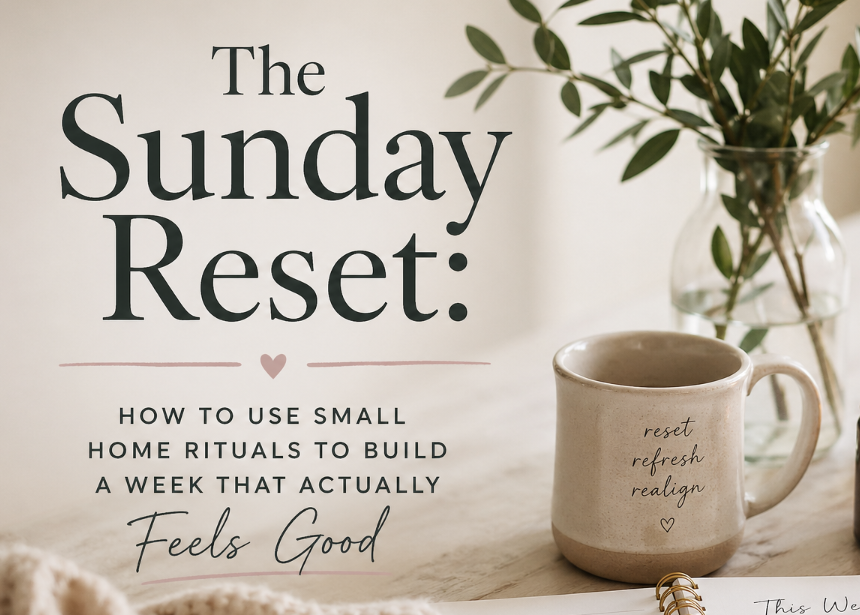
The Sunday Reset: How to Use Small Home Rituals to Build a Week That Actually Feels Good

There's a particular feeling that hits around 4 PM on a Sunday. The weekend is collapsing into Monday, the laundry isn't quite folded, and there's a low hum of dread about everything the week ahead is going to demand. Most of us try to fix it by powering through — a frantic cleaning sprint, a meal-prep marathon, an inbox purge — and we end up walking into Monday more tired than when the weekend started.
What we're actually craving isn't more productivity. It's a transition. A soft handoff from rest to readiness. And the most underrated way to create one is through small, sensory home rituals — the kind that involve lighting a candle before you fold towels, brewing a proper pot of tea before you plan your week, or stepping outside with bare feet for ninety seconds before you check your calendar.
This isn't wellness theater. It's something older and more practical. Cultures around the world have always used domestic ritual to mark thresholds — the lighting of evening lamps, the laying of a Sunday table, the closing of curtains at dusk. These weren't decorations. They were the quiet engineering of mood, of family, of the nervous system itself. And they worked because they engaged the senses in a way that screens and to-do lists simply don't.
Below is a guide to building your own Sunday reset — a sequence of micro-rituals across your home that take a combined ninety minutes, cost very little, and will quietly reshape how the next seven days feel.
The 4 PM Ritual: Reset the Light
The single most overlooked variable in how a home feels is light. Most of us live under one harsh overhead fixture — the kind installed by a contractor twenty years ago who was thinking about wattage, not warmth — and we wonder why our living rooms feel like waiting areas.
Sunday afternoon is the moment to fix this for the week ahead. Walk through your main living spaces and turn off every overhead light. Then turn on every lamp, every accent light, every string of bulbs you own. Notice what happens. The room contracts. Shadows soften. The walls move closer in a way that feels like an embrace rather than a constraint.
If you don't have enough secondary lighting to make this work, that's the project. You don't need expensive fixtures — a small table lamp on a console, a floor lamp angled toward a corner, a strand of warm bulbs along a bookshelf, and a couple of pillar candles on the coffee table will completely transform a standard living room. The general rule is at least three light sources at three different heights in any room you spend serious time in.
Set a recurring reminder on your phone for 4 PM every Sunday: "Reset the lights." This becomes your weekly cue that the workday weekend is over and the restorative weekend has begun.
The 5 PM Ritual: Reclaim One Surface
Clutter isn't actually about having too much stuff. It's about the absence of designated homes for the stuff you have. And the fastest way to feel like your house is conspiring against you is to walk in on Monday morning and be greeted by a kitchen counter buried in mail, water bottles, charging cables, and yesterday's grocery receipt.
The Sunday reclamation rule is simple: pick one high-traffic surface and clear it completely. Kitchen island, entryway console, bedroom dresser — whichever one bothers you most. Take everything off. Wipe it down. Then put back only what genuinely belongs there.
The trick is to make that surface beautiful enough that future-you will resist cluttering it. A small ceramic tray to corral keys and earbuds. A taper candle in a brass holder. A single stem in a bud vase — even a sprig of rosemary from the kitchen counts. A stack of two or three books with a found object on top. The principle is what designers call a "vignette": a tiny composition that signals to your own brain that this surface has a job, and that job is not to be a landfill.
Do this with one surface every Sunday for a month, and you'll have rotated through your whole house.
The 6 PM Ritual: The Dinner That Isn't About Dinner
There's a specific kind of Sunday meal that is not really about food. It's about marking the day. It doesn't have to be elaborate — a roast chicken, a pot of soup, a pan of baked pasta, a soft-boiled egg on toast if that's all you have in you. What matters is the staging.
Pull out the actual dinnerware. The cloth napkins that have been folded in a drawer for six months because you've been saving them for company. Light the candles you bought and never burn because they're "too nice." Use the wooden cutting board as a serving platter. Pour water into a pitcher instead of leaving the bottles on the table.
This isn't about fanciness. It's about telling your brain — and anyone you live with — that this meal is a real event, not a refueling stop. Children especially absorb this. A child who grew up with a Sunday table that meant something will, decades later, recognize the feeling and want to recreate it. That's how traditions actually start. Not with a grand declaration, but with a Tuesday in November when somebody decided to use the good plates for no reason.
If you live alone, this matters more, not less. Set the table for one. Sit down. Don't eat over the sink.
The 7 PM Ritual: The Outdoor Pause
Even if you have nothing more than a stoop, a balcony, or the strip of grass between your driveway and your neighbor's, step outside for the last hour of usable light. Bring a blanket and something warm to drink. Sit. Don't bring your phone, or if you do, leave it face-down.
This ritual matters because Mondays are almost always experienced indoors, under fluorescent light, in front of screens. By Wednesday, your body has forgotten what weather feels like. The Sunday outdoor pause is a kind of pre-loading — a reminder of seasons, of sky, of the size of the actual world relative to your inbox.
In warmer months, this might mean a string of bulbs over a small patio table and a citronella candle to keep the bugs off. In colder months, it might mean a fleece throw, a fire pit if you have one, or just a hot mug and a wool sweater for fifteen minutes on the porch. There is no version of this that requires a "real" outdoor space. A fire escape works. A driveway works. The point is the threshold — the act of putting your body somewhere with no walls around it before the week begins.
The 8 PM Ritual: The Bedroom Pre-Game
Most people treat the bedroom as the place where the day collapses — clothes thrown on a chair, phone plugged in next to the pillow, sheets that haven't been smoothed since they were slept in. Then they wonder why sleep doesn't come easily.
The Sunday bedroom ritual takes ten minutes. Strip the bed and remake it with fresh sheets — the single highest-leverage hospitality move you can perform on yourself. Mist the pillows lightly with a linen spray (lavender if you want to sleep, eucalyptus if you've been congested, neither if you don't have it). Switch the bedside lamp to its dimmest setting, or swap in a lower-wattage bulb specifically for the week ahead. Put the phone charger across the room, not next to the bed.
Then leave the room and don't go back in until you're actually going to sleep. The bedroom should not be the place you fold laundry, watch your laptop, or eat snacks on Sunday night. It should sit in waiting, slightly mysterious, like a hotel room you haven't checked into yet.
The 9 PM Ritual: The Soft Close
The final ritual is the smallest and the most important. Walk through your home one last time before bed. Turn off the lamps you don't need. Run a damp cloth over the kitchen counter you reset earlier. Fluff the pillows on the couch. Put the blanket back on the back of the chair.
This takes four minutes. It is not about cleaning. It is about leaving your home in a state where, when you walk into the kitchen at 6:30 AM on Monday morning to make coffee, you do not encounter evidence of last night's fatigue. You encounter a small kindness from yesterday's self.
That's really what all of these rituals add up to. Not productivity. Not aesthetics. A handful of practiced gestures that turn a house into a place that catches you when you fall, and lifts you a little when you need lifting. The week is going to come at you regardless. The question is whether your home is on your side when it does.
Putting It Into Practice
You don't need to do all six of these every Sunday. Start with two. The lights at 4 PM and the soft close at 9 PM are the highest-leverage pair if you only have time for two. Add the others as the rhythm starts to feel natural — usually around week three or four, your body will start anticipating them, the way it anticipates a meal at a regular hour.
The deeper truth here is that a home is not made by what you buy. It's made by what you do, repeatedly, in the spaces between what you buy. The candles, the lamps, the cloth napkins, the linen spray, the cutting board — these are tools. The ritual is the thing.
And the best week of your year is probably going to start on a Sunday afternoon, with you turning off an overhead light.
About the Author